Finds › Esagila, the temple of Marduk
Find 10
The Cyrus Cylinder
Persian period: after 539 BC, later than the city shown
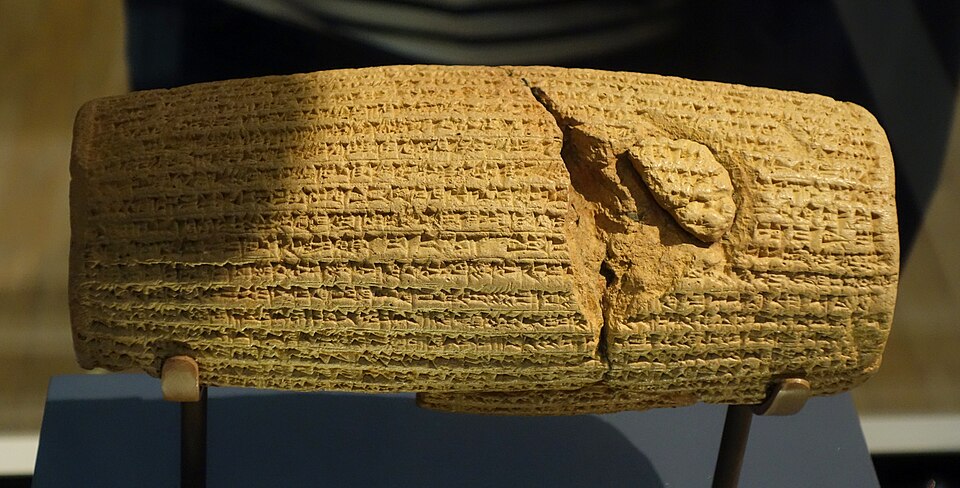
Photograph: Daderot, Wikimedia Commons (CC0) · source ↗

Cyrus's account of taking Babylon in 539 BC, written in Babylonian. It ends with his work on Imgur-Enlil, the city wall, during which an inscription of Ashurbanipal was found.
| Museum record | British Museum, London, 90920 ↗ |
| Date | 539 BC or soon after |
| Period | Achaemenid |
| Material | fired clay |
| Size | 22.8 cm long, 10 cm across at most, its ends 7.9-8.2 cm |
| Found | 'Amran (Babylon)': the mound Tell Amran ibn Ali, over Esagila (Rassam's digging, 1879) |
| On the map | Found in this place; the spot is not recorded: on the Amran mound, which covers Esagila; Rassam did not record the spot (the museum cites Walker 1972 for the evidence) |
| Its text names | Imgur-Enlil, the main city wall (east bank) |
Sources
- The British Museum, Collection online, object records by museum number (read through a browser, 2026-11-11), 90920. museum record open the work ↗find spot 'Amran (Babylon)'; 21.9-22.8 cm long, 10 cm maximum diameter
- O. Pedersén, Babylon: The Great City (Münster: Zaphon, 2021), ISBN 978-3-96327-136-6, open access, pp. 142-153. study open the work ↗Esagila lies under the mound Tell Amran
How to cite this entry
“The Cyrus Cylinder”, in Babylon c. 565 BC: the records, version draft (2026), find
“The Cyrus Cylinder”, in Babylon c. 565 BC: the records, version draft (2026), find
cyrus_cylinder, https://city.babyloniantwins.com/records-site/finds/cyrus_cylinder.html. Cite the museum record and the works above for the object itself.