Finds › Ištar Gate
Find 49
Dragon (mušḫuššu) from the Ištar Gate
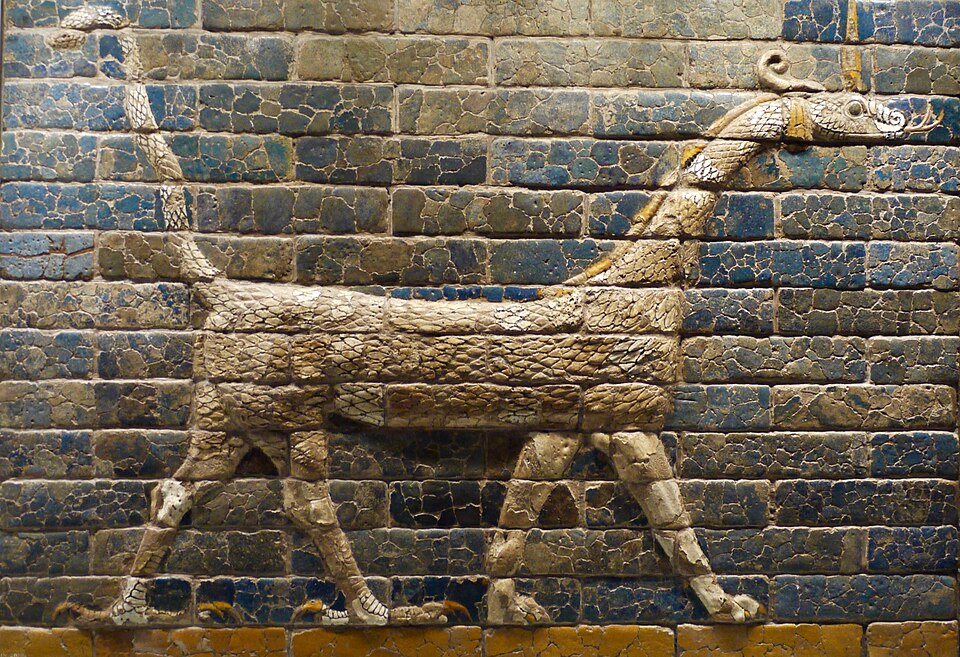
Photograph: Marie Thérèse Hébert & Jean Robert Thibault from Québec, Canada, Wikimedia Commons (CC BY-SA 2.0) · source ↗

The dragon of Marduk in moulded, glazed brick from the Ištar Gate.
| Museum record | Ny Carlsberg Glyptotek, Copenhagen, number not given in the sources read ↗ |
| Date | 604-562 BC |
| Period | Neo-Babylonian |
| Material | glazed brick |
| Found | the Ištar Gate (Commons' category of the museum's fragments) |
| On the map | Found in this place; the spot is not recorded: a dragon from the gate's glazed walls; where on the gate it stood is not recorded |
| In the model | Ištar Gate |
Sources
- Wikimedia Commons, file descriptions of photographs taken in the museums, which transcribe the museums' labels (read 2026-11-24), Danemark, Copenhague, Ny Carlsberg Glyptotek, le Dragon du dieu Marduk, 1000 à 500 avant J.-C. (32809948300).jpg. museum record open the work ↗Marduk (en akkadien, AMAR.UTU en sumérien) ou Mardouk, appelé aussi Bel-Marduk, Bellus-Marduk ou Baal-Marduk, est le plus grand dieu babylonien. Marduk est l'un des plus grands dieux sumériens ou mésopotamiens. ... Il est représenté par un dragon à tête de serpent.
How to cite this entry
“Dragon (mušḫuššu) from the Ištar Gate”, in Babylon c. 565 BC: the records, version draft (2026), find
“Dragon (mušḫuššu) from the Ištar Gate”, in Babylon c. 565 BC: the records, version draft (2026), find
glyptotek_dragon, https://city.babyloniantwins.com/records-site/finds/glyptotek_dragon.html. Cite the museum record and the works above for the object itself.